Tech News, Tech Iinfo Blog, Info Tech Blog
Singapore’s healthcare system delivers world-class outcomes, but it isn’t free at the point of use for everyone, and a sudden hospital admission can trigger a serious cash-flow problem even for families with decent savings. If you’re searching for Singapore hospital financing options, the short answer is that you have six main routes — MediShield Life, Integrated Shield Plans, MediSave, MediFund, employer benefits, and hospital instalment plans — and most people stack two or three of them. A standard Class B2 or C ward stay at a public hospital typically runs from about S$1,000 to S$8,000 out of pocket after subsidies and insurance, while a private hospital stay for major surgery can range from roughly S$15,000 to S$80,000 or more. Knowing which lever to pull, and in what order, is what keeps a medical bill from becoming a financial crisis.
Key Takeaways
- MediShield Life covers everyone, including pre-existing conditions, but pays only toward subsidized public hospital bills and has annual and lifetime claim limits.
- Integrated Shield Plans (IPs) sit on top of MediShield Life and are the main way to cover private or A-class hospital care — but you must pay the rider to avoid a large deductible.
- MediSave can be used for hospital bills, day surgery, and selected outpatient treatments, but withdrawal limits apply per day and per procedure.
- MediFund is the last-resort safety net for lower-income Singaporeans and requires applying through a Medical Social Worker at the hospital.
- Hospital instalment plans and zero-interest loans exist at all public hospitals — ask before discharge, not after.
- Employer medical benefits often cover a portion of hospitalization, but you usually must file the claim yourself within a deadline.
Six Main Singapore Hospital Financing Options
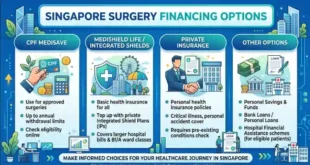
Most Singapore residents don’t rely on a single source. They combine a national insurance layer, a personal savings account, and either private insurance or a hospital payment plan. Here is how the six options compare.
| Option | Who It Covers | Typical Coverage | Key Limitation |
|---|---|---|---|
| MediShield Life | All citizens and PRs, automatically | Subsidized public ward bills above deductible | Claim limits; no private hospital coverage |
| Integrated Shield Plan | Those who buy it, usually via insurer | Private or A/B1 ward, above MediShield Life | Premiums rise with age; rider needed for full cover |
| MediSave | Citizens and PRs with CPF savings | Hospital, surgery, selected outpatient | Daily and per-procedure withdrawal caps |
| MediFund | Lower-income Singaporeans | Remaining bill after other schemes | Means-tested; needs social worker application |
| Employer benefits | Employees with group medical cover | Varies widely by employer | Claim deadlines; often capped annually |
| Hospital instalments | Any patient with a bill | Spreads payment over months | Not a discount; still owe the full amount |
The order matters. Hospitals and insurers generally require you to draw on MediShield Life and MediSave first, then MediFund if eligible, before any discretionary help kicks in.
How MediShield Life Actually Pays
MediShield Life is Singapore’s universal basic health insurance, administered by the Central Provident Fund (CPF) Board. It’s automatic and lifelong, and it can’t be cancelled for pre-existing illness. That last point is its greatest strength — no one is excluded.
But it’s designed for subsidized public hospital care, not private hospitals. It pays a portion of your bill after a deductible (an amount you pay first each policy year) and a co-insurance percentage (your share of the remainder). It also caps how much it pays per day for ward charges and per surgical procedure.
What MediShield Life doesn’t cover
- Private hospital bills in full — it pays only what it would have paid at a public hospital, leaving you the gap.
- Cosmetic procedures and most dental work.
- Maternity charges for the first two deliveries (though MediSave can help here).
- Bills below the annual deductible.
Pro Tip: If you’re admitted to a private hospital without an Integrated Shield Plan, you can end up paying the entire difference between the private bill and the public-hospital benchmark. Confirm your ward class before you sign the admission form.
Integrated Shield Plans Explained
An Integrated Shield Plan is private insurance that layers on top of MediShield Life. Five insurers offer them in Singapore, and each plan is tied to a ward class — B1, A, or private hospital. The higher the class, the higher the premium.
The critical detail most people miss: the rider. A rider is an add-on that reduces or removes the deductible and co-insurance. Without a rider, you can still face a bill of several thousand dollars even with an IP, because the deductible applies first. With a rider, your out-of-pocket is usually capped at a small annual amount.
Choosing between ward classes
| Plan Type | Covers | Annual Premium Range (approx., middle-aged adult) |
|---|---|---|
| B1 plan | B1 ward in public hospital | S$300 – S$700 |
| A plan | A ward in public hospital | S$500 – S$1,200 |
| Private hospital plan | Private and public A | S$900 – S$3,000+ |
Premiums are paid from MediSave up to a withdrawal limit, with the balance in cash. As you age, premiums climb steeply, so review your plan every few years rather than setting and forgetting it.
Using MediSave for Hospital Bills
MediSave is your own CPF savings set aside for healthcare. You can withdraw from it for hospitalization, day surgery, and approved outpatient treatments such as dialysis, chemotherapy, and radiotherapy.
Withdrawal limits apply. For hospital stays, there’s a daily ward charge limit and a separate limit per surgical procedure, both revised periodically by the Ministry of Health. For day surgery, a single combined limit applies. You can’t use MediSave to pay for the portion of a private hospital bill that exceeds what the same treatment would cost in a public hospital.
What you can and can’t pay with MediSave
- Can pay: hospitalization, surgery, approved outpatient scans and treatments, maternity for the first two births, and some vaccinations.
- Can’t pay: cosmetic surgery, most dental procedures, and bills already covered by another scheme.
Warning: MediSave isn’t a bottomless account. Heavy withdrawals in your 40s and 50s can leave you short for chronic illness later, so treat it as a reserve, not a first resort for small bills.
MediFund and Financial Assistance
MediFund is a government endowment fund that helps lower-income Singaporeans who can’t afford their remaining bill after subsidies, MediShield Life, and MediSave. It isn’t automatic — you must apply.
The application goes through a Medical Social Worker at the hospital. They assess your household income, savings, and the size of the bill, then decide the level of assistance. The hospital can also connect you to other schemes, such as the Community Health Assist Scheme (CHAS) for outpatient care or the ElderShield/CareShield Life payouts for long-term care needs.
How to apply for MediFund
- Ask to speak to a Medical Social Worker at the hospital’s billing or admissions office.
- Bring your NRIC, income documents, and the hospital bill.
- Complete the means-test form with the social worker.
- Wait for the assessment — most hospitals process this within a few working days.
- Receive a decision on how much of the bill MediFund will cover.
If you aren’t eligible for MediFund, the social worker can still point you toward hospital instalment plans or charitable funds.
Instalment Plans and Hospital Loans
Every public hospital in Singapore offers some form of instalment plan for patients who can’t pay a large bill at once. These are interest-free in many cases, or carry a low interest rate, and they spread the balance over several months.
The key is to ask early. Once a bill is overdue, it may be referred to a collection process, and the flexible options narrow. Speak to the hospital’s business office or a medical social worker before discharge if you already know the bill will be hard to clear.
Typical instalment terms
| Hospital Type | Instalment Period | Interest |
|---|---|---|
| Public restructured hospital | 3 – 12 months | Usually interest-free |
| Private hospital | 3 – 24 months | Varies; may carry interest |
| Credit card instalment | 6 – 24 months | 0% promos exist but read terms |
Some hospitals also accept post-dated checks or GIRO arrangements. If you have a credit card with a 0% instalment promotion, that can work, but only if you’re certain you can clear it before the promotional rate ends.
Employer Benefits and Insurance Claims
Many employers provide group hospitalization insurance. This is separate from your personal IP and often covers a fixed annual amount. The catch is that you usually must file the claim yourself, within a deadline, with the correct forms and receipts.
Check three things: the annual cap, whether it covers private or public hospitals, and the claim window. Some plans reimburse only after your MediShield Life and MediSave have paid, so keep every receipt and discharge summary.
If you’re self-employed or a gig worker, you have no employer layer, which makes your IP and MediSave even more important. The same applies to dependents who aren’t working and rely on a spouse’s coverage.
Comparing the Options Side by Side
The right combination depends on your ward class, income, and savings. Here is a practical way to think about it.
| Your Situation | Best Combination |
|---|---|
| Young, healthy, public B2/C ward | MediShield Life + MediSave |
| Mid-career, wants private option | IP with rider + MediSave |
| Lower income, large bill | MediShield Life + MediSave + MediFund |
| Employee with group cover | Employer plan + MediShield Life + MediSave |
| Self-employed | IP with rider + MediSave + instalment plan |
For most people, the backbone is MediShield Life plus MediSave, with an IP added if they want a higher ward class. MediFund and instalments are the safety nets when the bill outpaces everything else.
Common Mistakes to Avoid
- Assuming MediShield Life pays everything. It does not; deductibles and limits leave real gaps.
- Buying an IP without the rider. The deductible can still sting.
- Waiting until the bill is overdue to ask for help. Options shrink once collection starts.
- Ignoring employer claim deadlines. Miss the window and you forfeit the reimbursement.
- Over-drawing MediSave early. It leaves less for chronic conditions later.
Pro Tip: Before any planned admission, call your insurer and the hospital’s business office. Ask for a written estimate of your out-of-pocket cost after MediShield Life, MediSave, and your IP. That single call prevents most billing surprises.
Frequently Asked Questions
Can foreigners use MediShield Life or MediSave?
No. MediShield Life and MediSave are for Singapore citizens and permanent residents. Foreigners must rely on private insurance, employer coverage, or pay out of pocket. Some hospitals offer instalment plans to non-residents, but you should arrange private health insurance before treatment if you live or work in Singapore long term.
What happens if I can’t pay my hospital bill at all?
Speak to a Medical Social Worker immediately. They can assess you for MediFund, arrange an instalment plan, or connect you to charitable funds. Hospitals would rather set up a payment plan than send a bill to collections, so raising the issue early gives you far more options.
Is an Integrated Shield Plan worth the premium?
It depends on whether you want a higher ward class. If you’re content with subsidized B2 or C ward care, MediShield Life plus MediSave may be enough. If you want a private hospital or A-class option, an IP with a rider is the standard route, though premiums rise sharply with age.
Can I use MediSave to pay for a family member’s bill?
Yes, within limits. You can use your MediSave for a spouse, child, parent, or grandparent, subject to the same withdrawal caps and eligibility rules. You’ll need to submit the appropriate authorization form, and the hospital can guide you through it during admission.
Do instalment plans affect my credit rating?
Hospital instalment plans arranged directly with the hospital generally don’t report to credit bureaus the way a bank loan does. However, a credit card instalment plan does sit on your card, and missing payments there can affect your credit. Always confirm the terms in writing.
How do I check my MediShield Life claim status?
Log in to the CPF Board’s online portal with your Singpass. You can view your MediShield Life claims, MediSave withdrawals, and IP details there. If something looks wrong, contact your insurer or the CPF Board directly rather than waiting for the next bill.
Next Step
Start with the simplest action: log in to your CPF account and confirm your MediShield Life status, MediSave balance, and whether you hold an Integrated Shield Plan. Then, if you have a hospital bill in front of you, call the hospital’s business office and ask for a Medical Social Worker. That one conversation unlocks MediFund, instalment plans, and a clear written estimate of what you actually owe — turning an intimidating number into a manageable plan.